



Aluminium Pergola Lifespan: Why 20+ Years Is Credible

- AkzoNobel powder coating at 60-80 microns flexes to 6.3 mm without cracking through UK freeze-thaw cycles.
- 2.0-2.5 mm aluminium wall thickness prevents frame distortion and joint creep that budget 1.0-1.5 mm units develop by year 8-10.
- 10-year structural warranty covers frame, joints, footplates, and coating - but excludes accidental damage, modifications, and consumable parts like motor cables.
- Annual garden-hose rinse removes salt and pollen that degrade coatings; IP65-rated motors seal against dust and high-pressure water for decade-long service.
What does the 10-year structural warranty actually cover - and what doesn't it?
Ten years is genuinely industry-leading for a louvred pergola in the UK. Most competitors offer 2-5 years, if they publish a term at all. But a warranty is only as useful as its definition - so here's where the line sits.
What's covered: the 6063-T5 architectural aluminium frame, the welded joints, the footplates, and the powder coat finish on every structural component. If a frame joint fails, a footplate corrodes, or the powder coat lifts on the main structure within that decade, that's a claim.
What isn't covered matters just as much:
- Accidental damage - a fallen branch, an impact from moving garden furniture, storm debris
- Third-party modification - drilling additional fixings, attaching unrated loads, altering the frame
- Consumable parts - motor cables, rubber gaskets, and other wear items with their own service life
Every structural warranty in the industry draws that line somewhere. The difference is whether the manufacturer publishes it before you buy or stays vague about it until you file a claim.
One condition genuinely extends real-world lifespan beyond the warranty term: an annual garden-hose rinse. Five minutes a year, and it keeps salt, pollen, and grit from sitting on the coating through a British winter. Skip it on a coastal install and you'll see the difference by year twelve.
The motorised system carries its own longevity story, separate from the structural frame. The motors are IP65-rated - hermetically sealed against dust and high-pressure water - which matters as much for year eight as it does for the first proper downpour after installation.
The Pergola 4 Pro is the benchmark case here: the frame, joints, footplates, and coating that carry the 10-year term, on the model most UK buyers actually choose.
Why does 2.0-2.5 mm aluminium wall thickness matter more than any spec you'll see in a brochure?
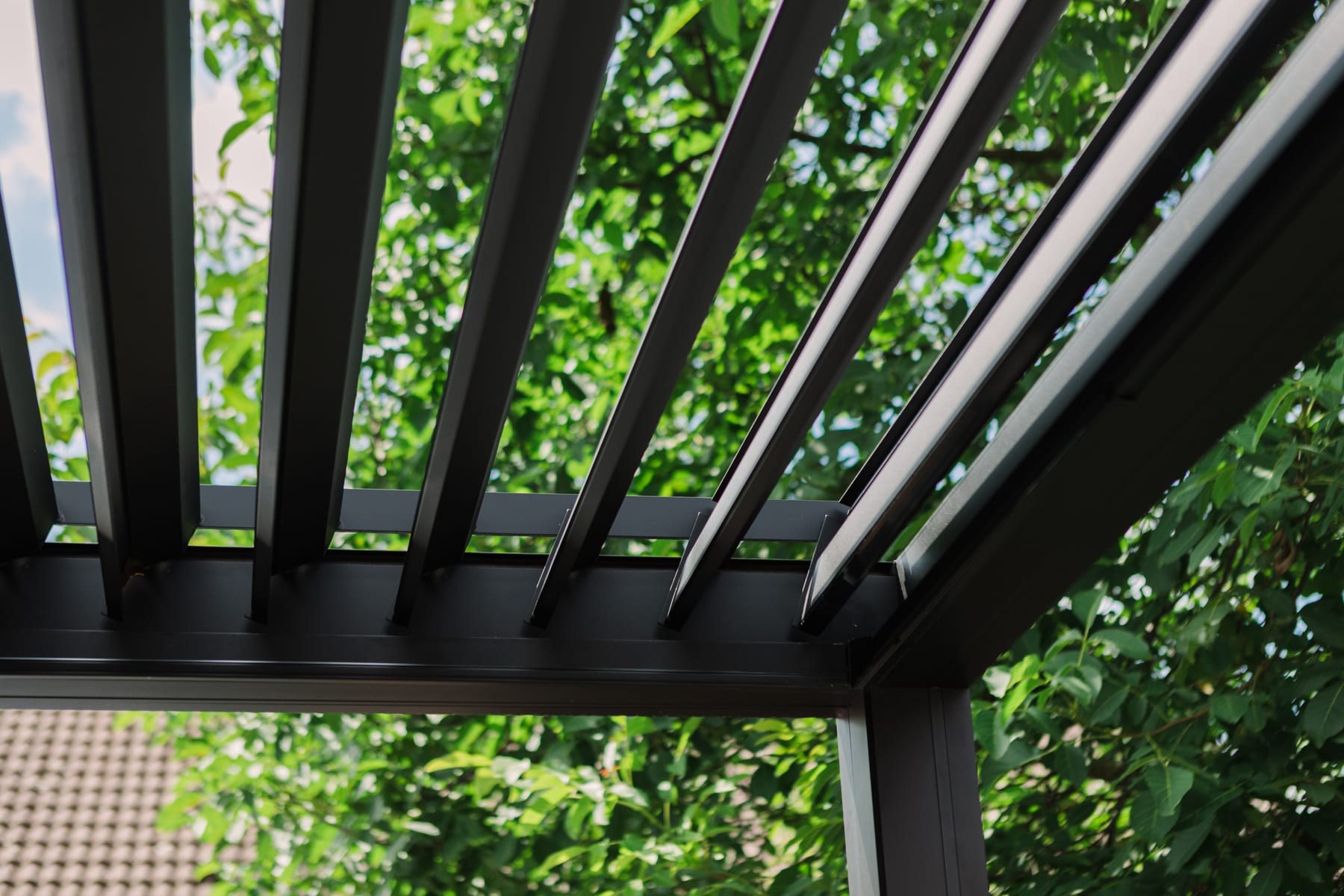
If you take one number from this article, take this one. Wall thickness is the single most predictive spec for how a louvred pergola behaves in year eight, not year one. PERGOLUX frames use 6063-T5 architectural aluminium at 2.0-2.5 mm. Budget units typically ship 1.0-1.5 mm - sometimes less than half the metal.
In showroom conditions, that difference is invisible. Both structures stand upright and look identical on delivery day.
The gap opens under cyclic load - the thousands of small flexes a frame absorbs from wind, thermal expansion, and its own moving louvres over a decade. At 1.0-1.5 mm, joints creep almost imperceptibly with each cycle. By year eight to ten, that creep surfaces as a faint vibration hum in moderate wind, louvres that no longer sit quite parallel because the frame has distorted slightly at its corners, and bolted joints that need periodic re-tightening because the metal around them has begun to fatigue. That's ordinary behaviour for thin aluminium under two decades of repeated stress, and no warranty claim will fix it.
At 2.0-2.5 mm, the frame has enough material mass to absorb that same cyclic load without permanent deformation. The geometry that leaves the factory is the geometry still standing in year fifteen.
PERGOLUX pairs this with 6061-T6 aerospace-grade aluminium - the same alloy used in aircraft wings - for the mechanical linkages and motor arms inside Pergola 4 Pro Max and Pergola 4 Pro. Structural frame and moving parts both get metal chosen for fatigue resistance, not just for passing a day-one load test.
Thicker profiles weigh more, so shipping costs a little more and assembly runs marginally longer with two people on ladders rather than one. That extra weight is exactly the point - it's the mass that keeps the frame geometrically stable through thousands of freeze-thaw and wind cycles.
How does AkzoNobel powder coating actually behave through 20 UK winters - and what does it look like in year 15?
Four numbers tell you most of what you need to know about a powder coating, and all four are published. Read them before you decide coating specs are marketing gloss - they're the only part of a pergola's finish you can check without waiting a decade.
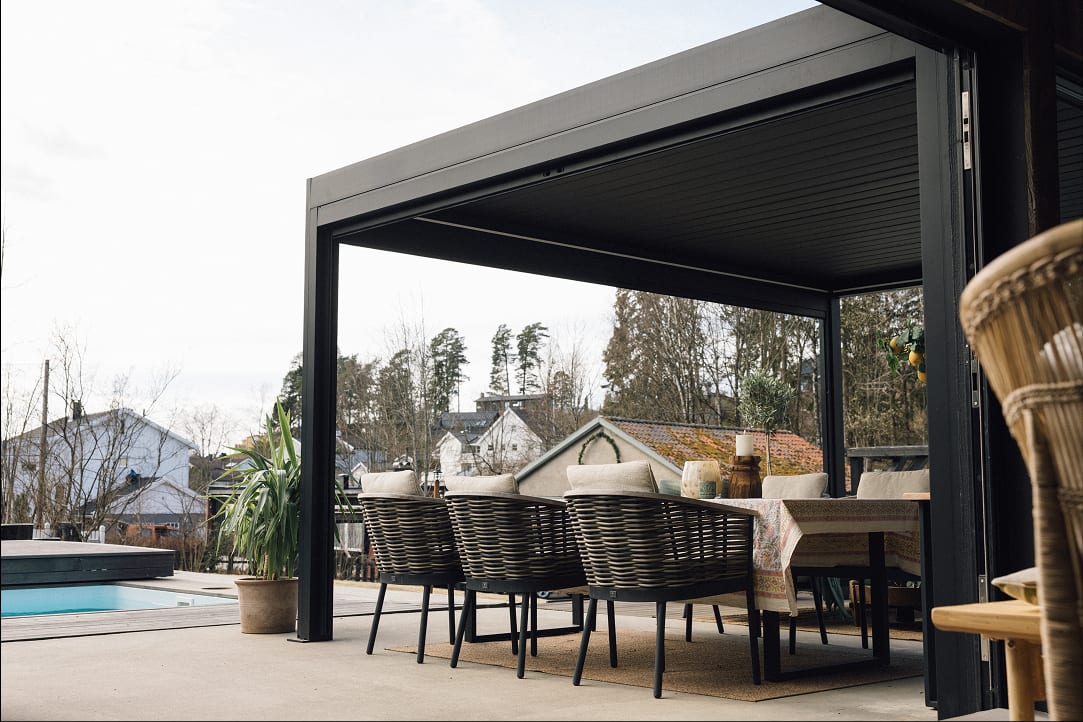
PERGOLUX uses AkzoNobel powder coating, scoring 100/100 adhesion in square-grid testing and a Hardness Score of 90 against an industry minimum of 80. It's applied at 60-80 microns and chemically bonded to the aluminium - a molecular grip, not a surface film. That's why the edges don't lift at the joints the way thinner budget coatings do after a few UK winters of freeze, thaw, wind-driven rain.
The elasticity figure is the one that predicts what you'll actually see outdoors. In cupping tests, the coating flexes to 6.3 mm before it cracks. That range covers the metal's own expansion and contraction between a −20°C (−4°F) January night and a 40°C (104°F) July afternoon in full sun.
That's the number that stops spider-web cracking at the frame joints, the failure mode you'll spot on cheaper structures by year six or seven.
Colour fastness is rated Level 4 under Xenon-Arc UV testing, against Level 2-3 for entry-level coatings. Combined with 73% gloss retention, the practical result is a structure that still looks clean and unfaded in year 15 without refinishing. Softwood greys within 3 years and needs annual oiling just to hold its colour - the maintenance clock starts the week it goes up and never stops.
Gouge it with a ladder foot or a spade edge, though, and you've exposed bare aluminium. That spot needs touching up, and the 10-year structural warranty covers manufacturing defects, not accidental damage. Left undamaged, the coating is engineered to hold its 60-80 micron barrier and Level 4 colour rating well past the decade it's guaranteed for - which is why the honest ownership figure for the structure is 20+ years, not 10.
Solid aluminium footplates versus steel: what does the base of a pergola tell you about how long it will last?
Nobody asks about footplates. Buyers ask about louvre thickness, motor warranties, colour options - the parts you look at. The part holding the whole structure to the ground gets ignored, which is exactly why it's the first thing to fail on a budget unit.
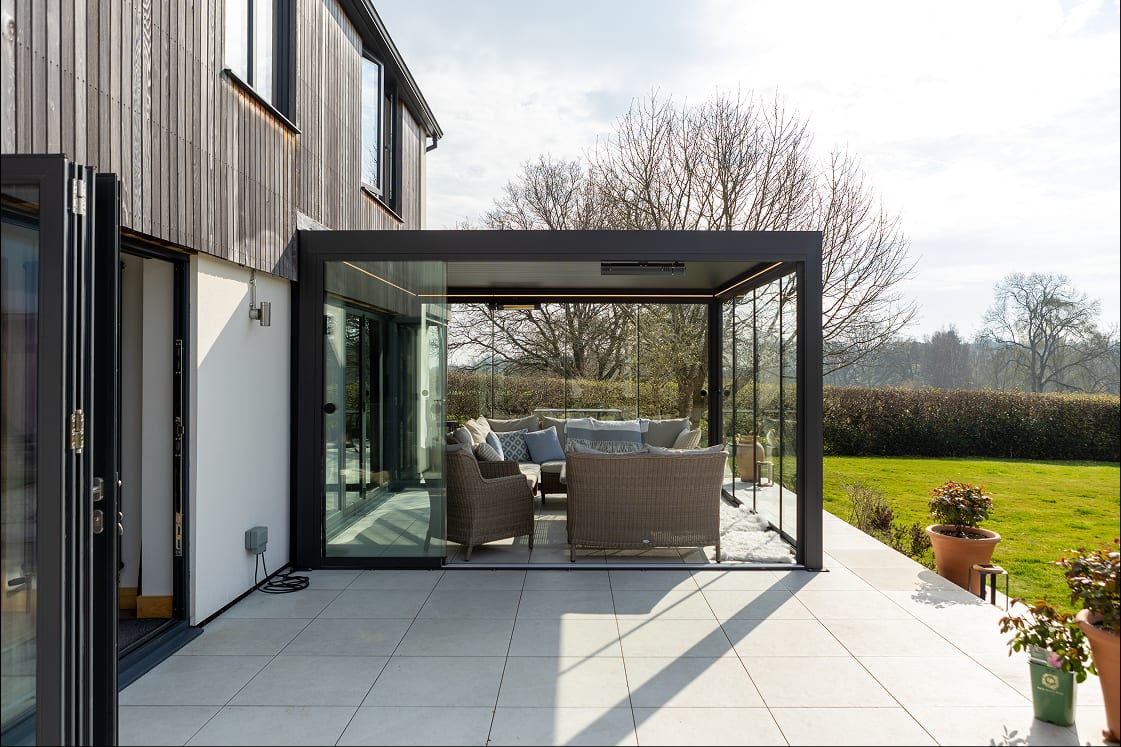
PERGOLUX uses solid aluminium footplates, up to 200 × 200 mm, on every model. Budget louvred pergolas typically use steel. Steel is cheaper to stamp and cheaper to buy, and it rusts. In UK ground conditions - rain, patio damp, winter salt run-off - surface corrosion on an unprotected steel footplate starts within 2-3 years.
By year five, that corrosion has usually migrated. Orange staining appears on the paving around the base, which is a cosmetic problem to begin with and a structural one shortly afterwards. As the steel profile corrodes it distorts, and the joint between footplate and post loosens. That's the actual failure mode on most budget units. Skip the motor and the louvres - the base connection is what works itself loose underfoot, and you feel it as a slight sway before you ever see the cause.
Aluminium behaves differently. It oxidises at the surface and stops there. No migration, no bleed onto the paving, no joint creep.
Beaufort Scale 12 certification is worth reading as a longevity spec as much as a storm spec. To survive gusts up to 118 km/h (73 mph), a structure needs fatigue margin in every joint - footplate, post, frame - because wind doesn't load a pergola once, it loads it thousands of times over twenty years. Engineer to that ceiling and ordinary Cornish coastal wind sits comfortably inside the design envelope.
If your site sits exposed - coastal, elevated, open to prevailing wind - the Pergola 4 Pro Max for coastal sites carries the same solid aluminium footplate engineering with the higher structural rating built around it.
Back to Blog