



What is a bioclimatic pergola? The UK buyer's guide

- Bioclimatic pergolas use rotating aluminium louvres to manage sun, rain, and airflow passively—no fixed roof needed.
- Pergola 4 Pro handles Beaufort Scale 12 winds (118 km/h / 73 mph) and 320 kg/m² snow load year-round.
- Internal gutters 50% wider than industry standard prevent pooling; 130° louvre rotation captures winter sun fixed roofs miss.
- Motorised Pergola 4 Pro costs £6,000–£7,000 for a 3×4 m structure; manual Pergola 4 runs £4,000–£5,000.
- Unlike gazebos or awnings, bioclimatic pergolas require daily louvre operation to stay watertight—that interaction is the design.
What does 'bioclimatic' actually mean - and is it just marketing?
The word comes from architecture. Bioclimatic design is the practice of using a building's physical form to moderate the climate around it - adjusting shade, airflow, and light passively, without mechanical heating or cooling. A bioclimatic pergola applies that principle to a single mechanism: rotating aluminium louvre slats that you tilt to manage sun angle, rainfall, and ventilation. That's it. Not a brand name. Not a style category. A description of what the roof does.
The louvres sit horizontally when you want rain channelled to the internal gutters. They angle open when you want airflow or shade. Close them fully and the roof is watertight; open them wide and you're sitting under open sky. The slats move - that's the entire distinction from every other garden structure.
Compare that to what a bioclimatic pergola is not. A fixed-roof gazebo blocks light whether you want it to or not, traps heat in July, and cuts off winter sun entirely. A polycarbonate lean-to gives you passive shelter - rain stays out, but so does airflow, and the material yellows within three to four years in UV. A standard awning shades a patio but must retract the moment wind picks up or rain arrives; it adds no usable space and protects nothing underneath it.
The honest tradeoff: a bioclimatic pergola is not passive shelter. The louvres need to be closed - manually or by motor - for the roof to be watertight. That operation is part of daily use, not an occasional adjustment. If you want a structure that requires zero interaction, a fixed roof is simpler. If you want a garden structure that adapts to the British weather rather than surrendering to it, the mechanism is the point.
Does a bioclimatic pergola actually work in UK weather?
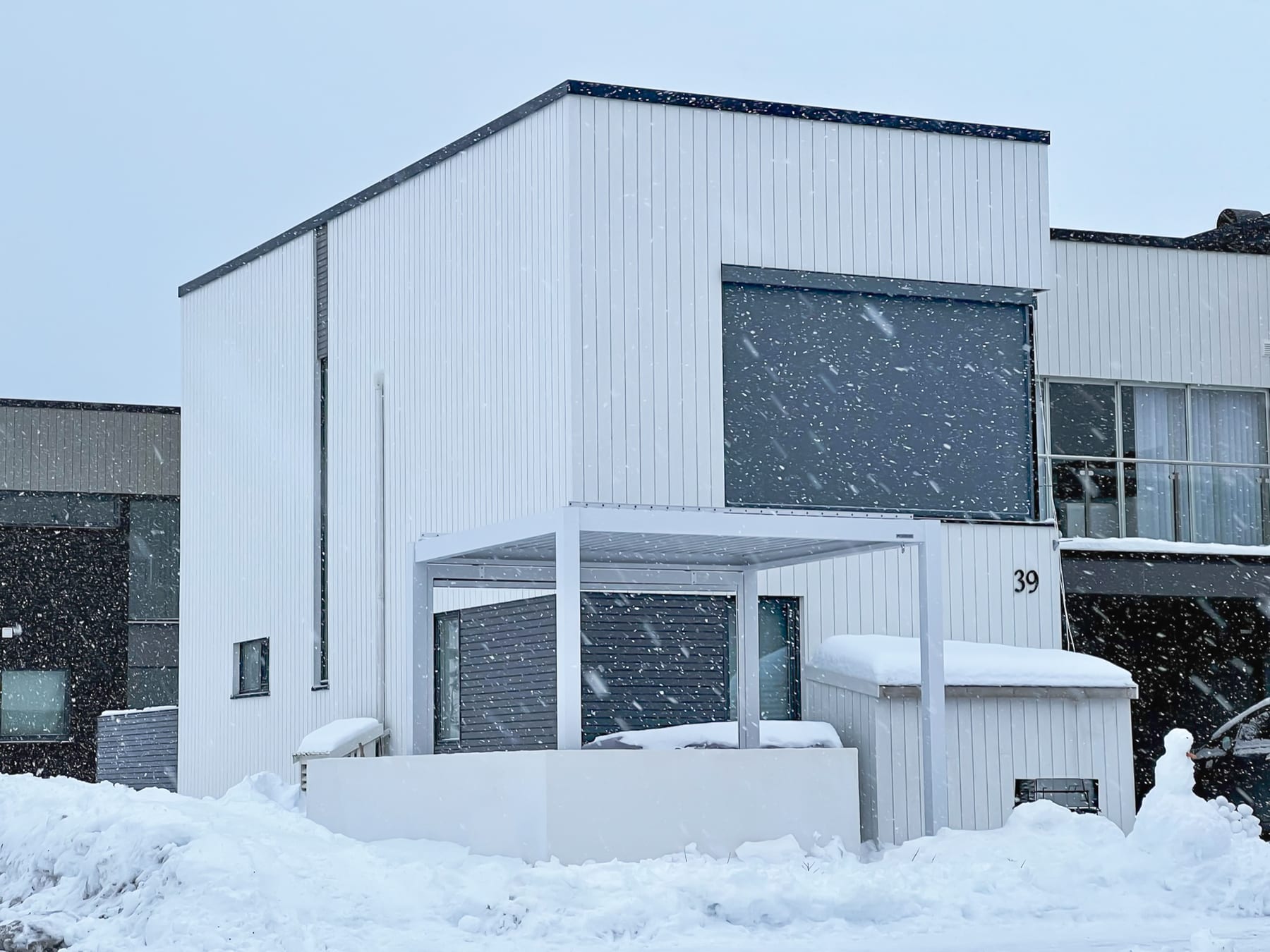
The honest version of this question is: does it work when the weather is bad? Because in the UK, that's most of the time. The answer is yes - and not in spite of British weather, but because of it.
Take wind. A louvred roof that can't handle Atlantic gusts is useless in Cornwall, exposed gardens along the North Sea coast, or anywhere in the Scottish Highlands from October through April. The Pergola 4 Pro is TUV-certified to Beaufort Scale 12 - that's 118 km/h (73 mph), the wind speed at which other structures are already broken or retracted. When a named storm tracks across the south-west, you close the louvres and the roof holds. The structure doesn't become a liability at the exact moment you need shelter most.
Rain channelling is where the engineering earns its place on a wet Tuesday. When the louvres are closed, internal gutters collect every drop and funnel it through the structural posts to the ground. PERGOLUX's internal gutters are 50% wider than the industry standard, with a 1.5 cm height differential between sides - so water drains continuously rather than pooling, and there's no dump of standing water when you tilt the louvres open again after a shower.
Snow load matters more than most UK buyers assume. Scottish Highland winters and high-ground gardens across Wales, the Pennines, and the Lake District see accumulation that would buckle a budget gazebo roof. The Pergola 4 Pro is rated to 320 kg/m² - roughly 2,900 kg on a 3×3 m roof. That's the weight of a large SUV sitting on the frame.
Grey shoulder seasons - October through March - are where the real case is made. A fixed gazebo roof blocks the low winter sun you actually want. Louvres angled to 130° pull in that raking autumn light that a 90° system misses entirely. You're not just staying dry; you're staying warm when warmth is scarce. Add Glass Walls and the pergola becomes a genuinely usable outdoor room through the coldest months.
The one honest concession: on a perfect British summer afternoon, any roof structure provides shade. The louvred design earns its price premium across the other nine months. If your garden sees sun twelve weeks a year, the motorised system's ability to manage those other forty weeks is what justifies it.
How much does a bioclimatic pergola cost in the UK?
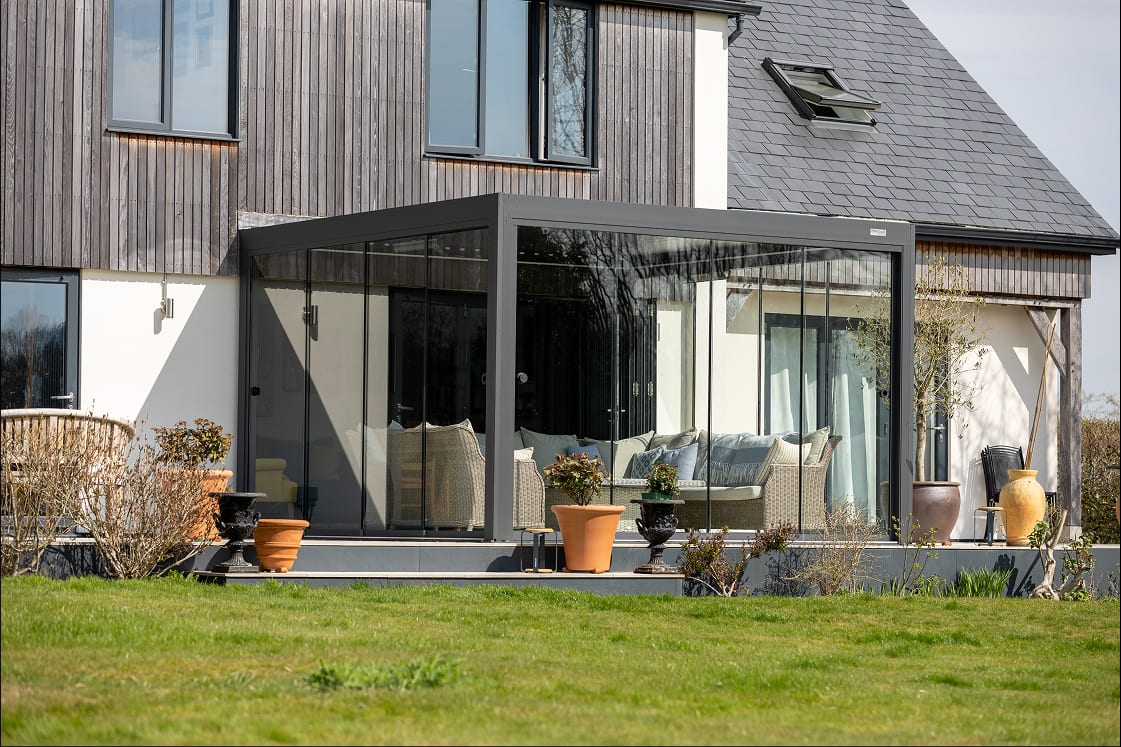
The honest answer spans a wide range - because size, motorisation, and accessories each move the number significantly. Here is where things land for most UK buyers.
| Configuration | Typical price | What you get |
|---|---|---|
| Pergola 4 - manual louvres, 3×4 m | £4,000–£5,000 | Structural aluminium frame, crank-operated louvres, internal drainage, 10-year warranty |
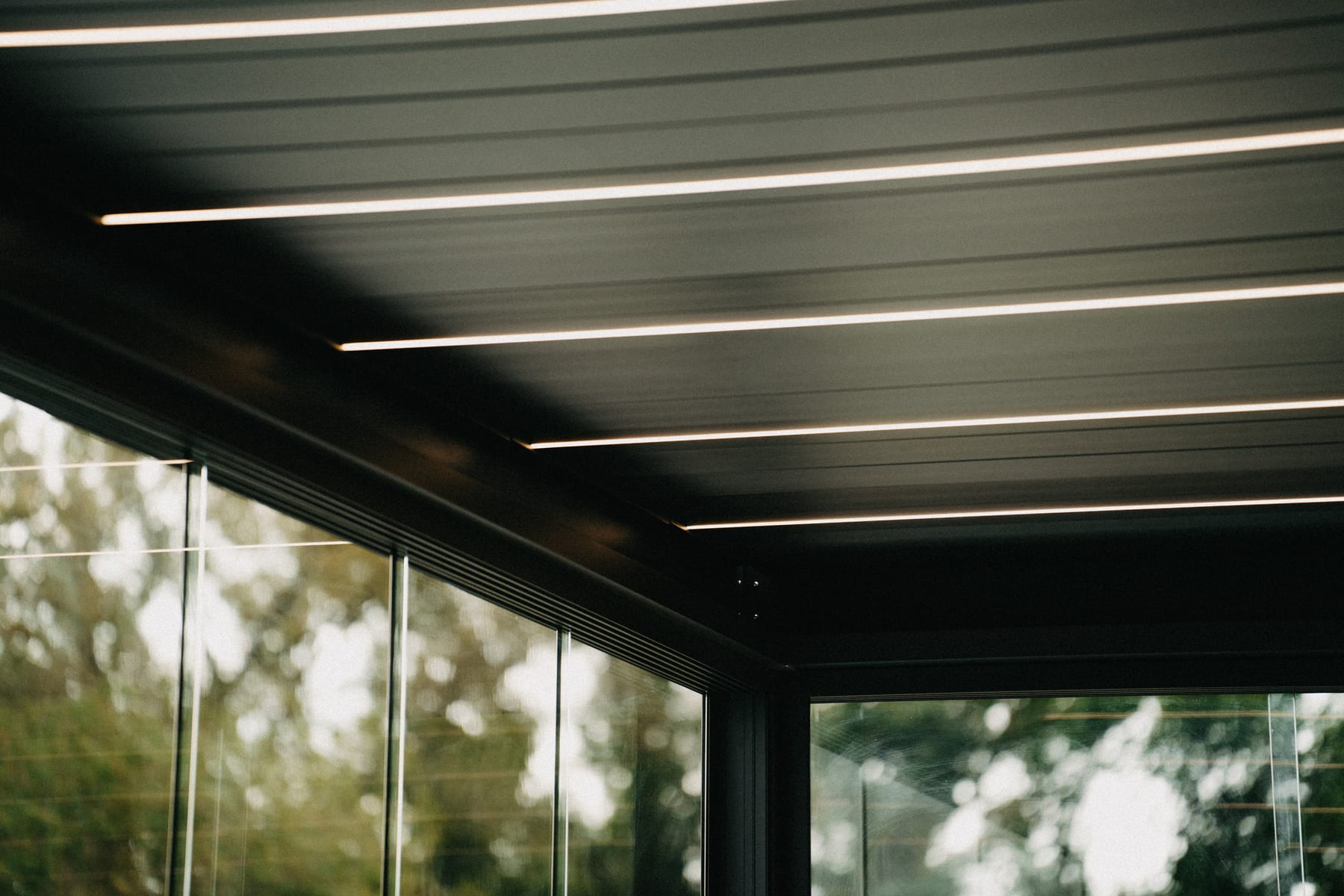
| Pergola 4 Pro - motorised, 3×4 m | £6,000–£7,000 | App and remote louvre control, integrated LED gutter lighting, smart-home compatibility |
| PERGOLUX Custom Design - motorised, bespoke sizing or accessories | £5,000+ | Non-standard footprints, Glass Walls, heaters, full enclosure configurations |
| Basic polycarbonate-roofed gazebo | £1,500–£4,000 | Passive shelter only - no louvre adjustment, no drainage engineering, typically unrated for wind or snow load |
| Brick conservatory (comparable footprint) | £40,000–£80,000 | Fixed enclosed room - planning permission usually required, 6-month build timeline typical |
Four things move the price on a bioclimatic pergola. First, size - you are buying square metres of engineered aluminium, so a 4×5 m structure costs meaningfully more than a 3×3 m one. Second, motorisation versus manual - the Pergola 4 Pro's motorised system adds roughly £2,000 over a manual equivalent. That premium buys daily-use convenience and weather-responsive automation, not just a remote control you press twice a year. Third, accessories: Glass Walls, a PERGOLUX Heater, or integrated LED lighting each add to the base cost but also extend the structure's usable months into winter. Fourth, custom sizing - gardens that fall outside standard footprints require bespoke fabrication.
The conservatory comparison is worth holding onto. A brick-and-glass conservatory at £40,000–£80,000 delivers a fully enclosed room - but it also needs planning permission in many cases, a six-month build, and a contractor on site for weeks. A bioclimatic pergola installs in a weekend with two people, typically falls under permitted development (no planning permission required for most residential installs - check the planning permission guide for your specific situation), and Building Regulations Part A applies for structural sign-off where relevant.
Property value follows the investment. Comparable data from the National Association of Realtors puts outdoor living structure uplift at 5–15% of home value. For a £400,000 UK property, that is £20,000–£60,000 - well above the cost of even a custom-configured build.
Lead time matters too. Industry average for a custom garden structure is 12–16 weeks. PERGOLUX ships in 1–2 weeks from order.
The tradeoff to name plainly: the manual Pergola 4 is the cheaper entry, but if you are closing louvres against a November downpour at 7 AM, you will reach for the motorised app every time. The price gap between manual and motorised is real. So is the daily difference.
Aluminium, timber, or polycarbonate - which lasts in UK conditions?
Three materials dominate this category. Only one makes sense for a UK garden that sees salt air, wind-driven rain, and UV cycling through every season.
Aluminium is the structural material of choice for bioclimatic pergolas, and the coating is where the real performance story lives. PERGOLUX uses AkzoNobel powder coating - the same finish applied to Aston Martin bodywork and NASA components - at 60–80 microns of depth, with a 100/100 adhesion score in square-grid testing and a hardness rating of 90 against an industry minimum of 80. Under Xenon-Arc UV testing it achieves Level 4 colour fastness, where entry-level garden structures sit at Level 2–3. The result: no peeling, no spider-web cracking, and no fading through repeated -20 °C to +40 °C cycling. A properly coated 6063-T5 aluminium frame lasts 20+ years with no refinishing. You clean it with a garden hose.
Timber has a genuine advantage: warmth. The visual character of a hardwood frame is real, and no aluminium structure replicates it. If aesthetics is the primary decision driver and your garden isn't exposed to coastal salt air, timber has a legitimate case. But the maintenance reality matters. Untreated or under-maintained timber greys within three years in UK rainfall. In a coastal or rain-heavy garden - Cornwall, the Lake District, the North Sea coast - rot sets in well before the structure earns back its cost. Realistically, an unmaintained timber pergola lasts 8–12 years. Annual oiling is not optional; it's the cost of ownership.
Polycarbonate-roofed gazebos are the cheapest entry point and the shortest-lived. The panels yellow under UV within four to five years. There are no louvres, no rain channelling, no airflow management - just passive shelter that degrades visibly. For a long-term garden investment, polycarbonate is the wrong starting point.
The honest tradeoff for aluminium: it does not carry the warmth or character of timber. If you want the look of a natural wood frame and you're prepared to maintain it, timber is a real option for inland, lower-exposure gardens. For coastal installs or anyone who wants to stop thinking about their garden structure, aluminium is the only material that doesn't ask anything of you after the first weekend.
For coastal gardens or larger spans where structural mass matters, the Pergola 4 Pro Max is rated to Beaufort 12 winds and carries TUV certification that no timber frame in this category can match. Pair it with a PERGOLUX Heater if shoulder-season use is a priority - aluminium's thermal efficiency means a closed louvre roof retains warmth far more effectively than an open timber canopy.
Back to Blog