



Design Your Pergola Without the Guesswork — Free Consultation

- Virtual consultations cover site conditions, intended use, and finish preferences in 20-30 minutes with a written recommendation.
- AkzoNobel powder coating (100/100 adhesion, Level 4 colour fastness) holds colour for decades - see finish samples in person if colour choice matters to you.
- Bring garden dimensions (paced out is fine), three photos including the house view, any planning constraints, and your use-case description.
- Showroom visits let you see Glass Walls at full 2 m scale and compare finishes in natural light - worth the journey if colour or enclosure depth is uncertain.
- The consultant asks questions about site exposure, your intended use, and finish preferences - then gives you a firm model, dimensions, and accessory recommendation.
What does the free design consultation actually cover - and is it just a sales call?
It isn't. That's the short answer, and it's worth saying plainly because most people arrive with that suspicion - reasonably so, given how often "free design consultation" in the home improvement world means "sit through a 45-minute pitch." The PERGOLUX consultation works differently. Nobody is trying to close you.
The session moves through three stages, in order. First, site conditions: garden orientation, how exposed the space is to wind and rain, whether any planning constraints apply to your property. Second, intended use - not in the abstract, but specifically: everyday dining, occasional weekend hosting, a proper year-round garden office, or some combination. Third, finish preferences: colour, how enclosed you want the space to feel, whether accessories like Glass Walls or Retractable Screens belong in the picture from day one. The consultant asks questions. You answer them. That's the dynamic.
At the end, you receive a written configuration recommendation - the model, the dimensions, the finish, and any accessories that make sense for your site. No obligation. No countdown timer.
The honest tradeoff: a virtual consultation covers the structural and functional decisions well. What it can't do is show you what AkzoNobel powder coating actually looks like on an aluminium frame in natural light, or let you run your hand across the finish you're choosing for the next two decades. If colour and texture are where your uncertainty lives, the showroom visit resolves that in about ten minutes. If you already know you want anthracite grey and you just need to know which model fits your garden, a virtual session is entirely sufficient.
Most consultations take between 20 and 30 minutes. You'll know what to order - or whether to order - by the end.
Virtual or showroom - which format actually helps you decide?
Both formats cover the same ground: site conditions, dimensions, model fit, accessories, finish. The difference is what a screen genuinely cannot replicate.
The virtual consultation runs as a screen-share. You share photos, the consultant walks through configuration options live, and most customers leave with a clear recommendation inside an hour. If you already have your garden measurements and a few photos from different angles, this is the faster route. No travel, no diary pressure - and for straightforward rectangular gardens with no unusual exposure, it's genuinely sufficient.
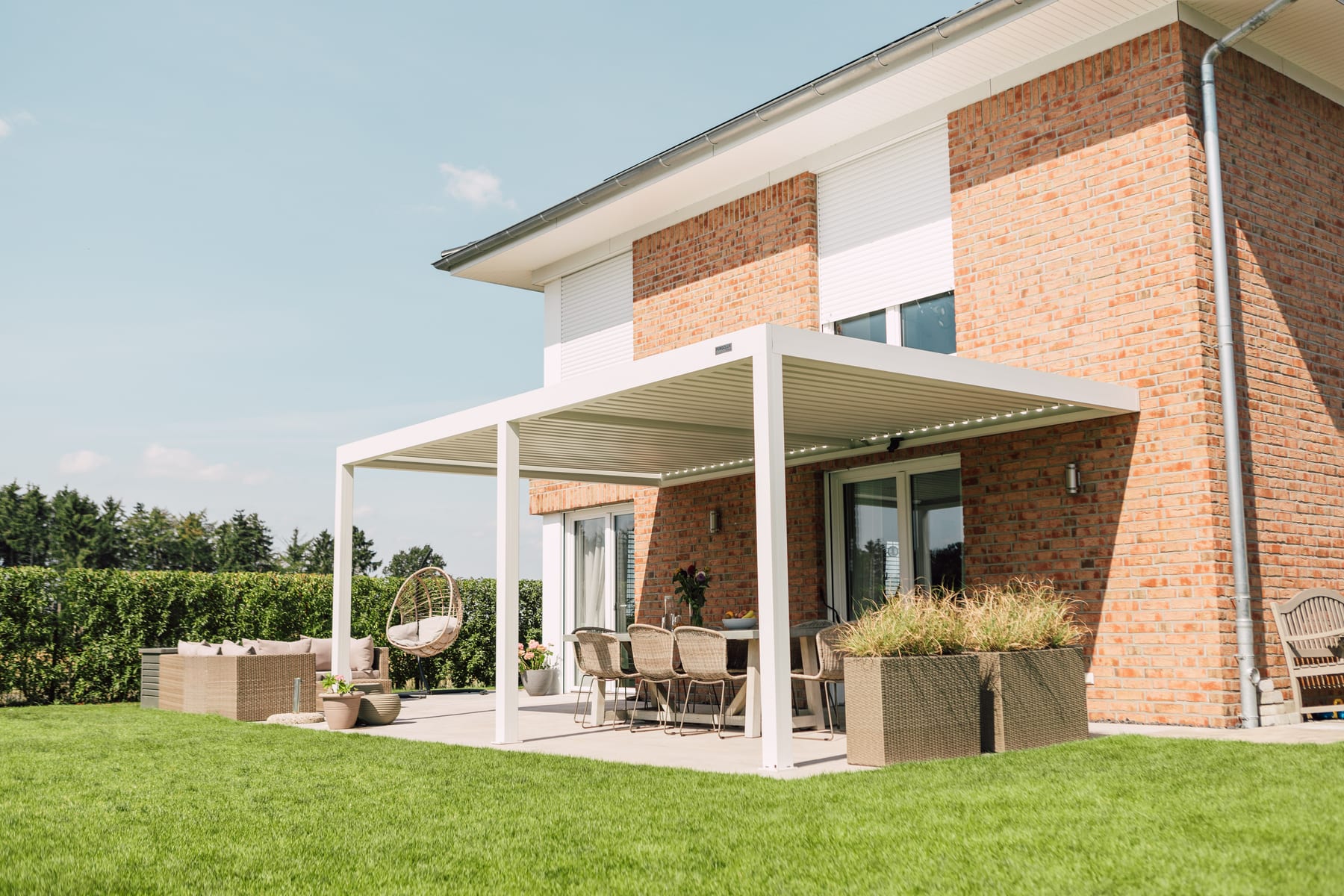
The showroom is a different experience for one specific reason: colour and finish decisions are almost impossible to make from a screen. The AkzoNobel powder coating - 100/100 adhesion score, Level 4 colour fastness - holds its colour for decades, which means the shade you choose now is the shade you're looking at in 2036. Getting that choice wrong matters. Seeing the finish panels in person, in natural light, removes the uncertainty that screen swatches create. That alone is worth the trip for customers who care about how the pergola reads against their brickwork or fencing.
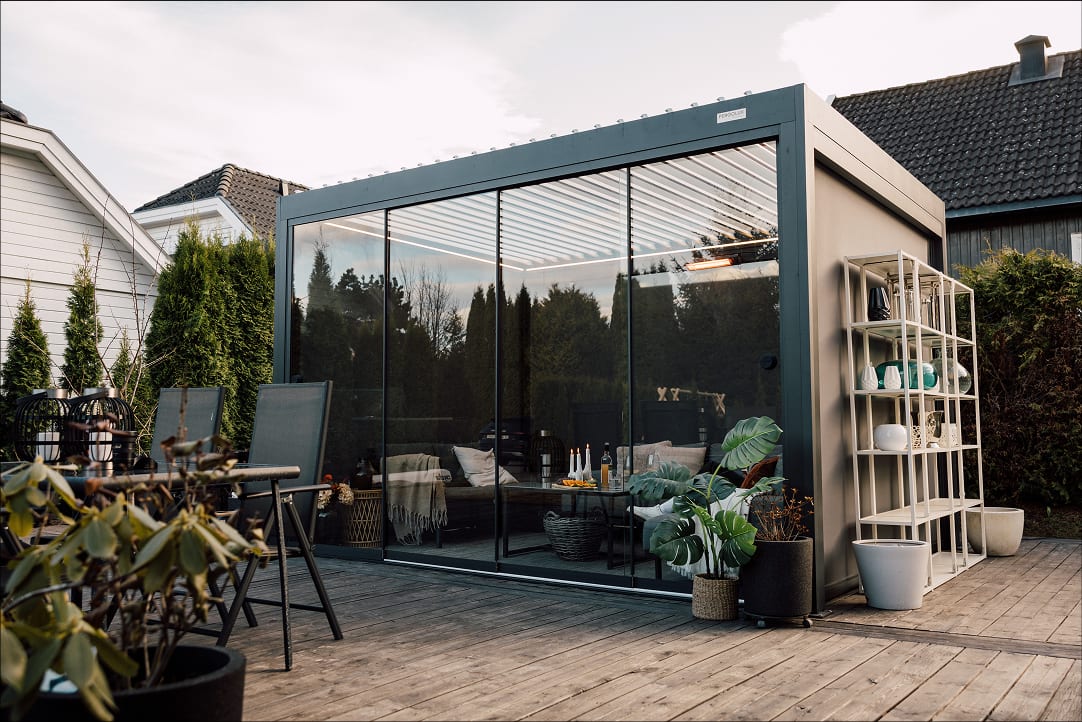
The showroom also has Glass Walls on display at full scale - not a rendering, not a photo. There is a meaningful difference between understanding intellectually that an enclosure panel is 2 m tall and standing next to one. Retractable Screens and Aluminium Slat Walls are displayed the same way.
The honest tradeoff: if you're two hours from the showroom, the virtual format handles most configurations without compromise. But if finish choice or enclosure depth is keeping you from committing, the journey pays for itself.
What should you bring to the consultation - and how long does it take?
Not much - and certainly not a surveyor's plan. The consultant's job is to help you get from rough information to a firm recommendation, so imprecise measurements are genuinely fine as a starting point. What matters is that you arrive with four things.
- Garden dimensions. Length, width, and the distance from the house wall to where the structure will sit. Pacing it out is acceptable. If you're off by 20 cm, the consultant will catch it during the configuration review.
- Photos from at least three angles - including one looking back at the house. The angle from the garden toward the façade is often the most useful: it shows how the pergola will read against the brickwork, the windows, and any existing features like doors or guttering.
- Any planning constraints. Listed building status, proximity to a boundary, or any local covenant equivalent. If you're not sure whether a constraint applies, bring that uncertainty - the consultant can flag what typically triggers a requirement and what doesn't.
- A rough use-case description. "We eat outside most evenings from April to October, and we'd like to use it for a morning coffee through winter" is more than enough. You don't need a brief. You just need a sense of how the space will actually live.
If you don't yet know what style you want, that's not a problem - it's actually the best reason to book the showroom visit early rather than late. Seeing the AkzoNobel finish options in person, in the light, alongside the physical frame, tends to clarify preferences that a screen never quite resolves.
On timing: virtual consultations typically run 20-30 minutes. In-person showroom visits are usually 30-45 minutes, not because there's more to cover, but because you'll want to look at things twice.
How does the consultant narrow down the right model - and what does the decision logic actually look like?
The recommendation you leave with isn't a guess dressed up as expertise. It follows a clear sequence - and understanding that sequence means you can interrogate it rather than just accept it.
The first filter is wind exposure. A garden on the Cornish coast faces fundamentally different conditions than a sheltered urban terrace in Leeds. The consultant asks about your site's exposure - roughly, whether you're open to prevailing winds, flanked by fencing or buildings, or somewhere in between. This shapes the structural conversation more than anything else.
The second filter is how you'll actually operate the roof. For most UK gardens, this is where the decision between the Pergola 4 and the Pergola 4 Pro is made - and it's almost never about size. The Pro adds motorised louvres with IP65-rated motors, hermetically sealed against rain and dust. On a grey November afternoon when horizontal drizzle arrives without warning, reaching for your phone to close the roof is a different proposition entirely from heading outside with a crank handle. The consultant won't dramatise this, but they will ask honestly how often you expect that scenario to play out.
The step from Pergola 4 to Pergola 4 Pro is almost always about motorisation and weatherproofing - not size.
The third filter is span. The Pergola 4 Pro Max covers up to 6 m (20 ft) without a middle post. That's not a marginal difference - an unobstructed 6 m overhead changes how a space reads and how naturally it flows. The Pro Max also carries 245 mm louvres against 160 mm on base models; the aperture when open is wider, and the quality of light underneath is visibly different. The showroom is genuinely the best place to feel this, but a consultant can describe it clearly enough that you'll know whether it's relevant to your site.
Beneath all three filters sits the frame specification. The consultant's job here is to translate the datasheet into plain terms: 6063-T5 architectural aluminium at 2.0-2.5 mm wall thickness is what separates a structure that holds its geometry for twenty-five years from one that flexes and corrodes in a decade. Budget alternatives typically run 1.0-1.5 mm. You don't need to care about the alloy designation - you just need to know that the difference is measurable and auditable, and the consultant can show you where to look.
By the end of this part of the conversation, the model question is usually settled. What follows is accessories - but that's a separate stage, covered next.
What do you actually leave with - and what happens next if you want to go ahead?
At the end of the consultation, you receive a written configuration summary. Model, dimensions, colour, chosen accessories, and an estimated lead time - all in one document. Nothing is locked in. You can take it away, share it with a partner, sit on it for a fortnight, and come back when you're ready. The configuration waits; you're not losing a slot or a price by thinking it over.
If your garden falls outside the standard footprint range, that's not a dead end. PERGOLUX Custom Design exists precisely for those cases - irregular shapes, larger spans, sites that don't fit a catalogue option neatly. The consultant flags this during the call, so you leave knowing which route applies to you rather than discovering it later.
When you do decide to proceed, the timeline is worth knowing in advance.
Lead time from order to delivery is 1-2 weeks - not the 12-16 weeks that most outdoor structure suppliers quote as standard. That gap matters. Many homeowners put off the decision in March because they assume they'll be waiting until June. In practice, you can book a consultation this week, place an order next, and be assembling the frame before the month is out.
The 10-year structural warranty covered earlier means the decision, once made, is well protected. The configuration is ready when you are. Nothing about the next step is complicated.
Back to Blog